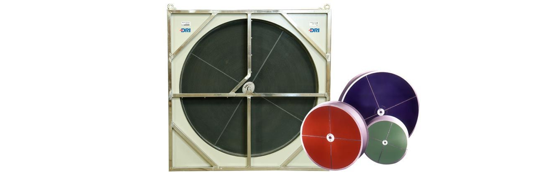

Humidity can affect product quality, equipment reliability, storage conditions and process consistency across industrial facilities. Conventional air conditioning may reduce moisture while cooling the air, but it does not always achieve the low humidity levels required by moisture-sensitive operations. Pharmaceutical manufacturing, food processing, electronics production and cleanroom environments often need tighter control over moisture content. A desiccant dehumidification wheel addresses this requirement by removing water vapor through adsorption rather than relying only on cooling and condensation. Its continuous operation makes it suitable for industrial systems that need stable humidity control across changing operating conditions.
A rotary desiccant system uses a moisture-attracting material arranged within a honeycomb structure. Process air passes through one section of the rotating wheel, where the desiccant captures water vapor. The wheel then moves into a separate regeneration airstream, where heat releases the retained moisture. This repeating process allows the rotor to continue drying incoming air without requiring the entire system to stop for moisture removal.
How Does a Desiccant Dehumidification Wheel Work?
The desiccant wheel operates through adsorption, a process in which water vapor attaches to the surface of a moisture-attracting material. Unlike absorption, which involves moisture entering the bulk of a substance, adsorption takes place primarily on available surfaces and within the material’s porous structure. The rotor contains a large contact area because its media is formed into narrow, closely spaced passages. As humid process air moves through these passages, water molecules transfer from the airstream to the desiccant. The resulting supply air has a lower moisture content, although its temperature may increase during the process.
The rotor is divided into process and regeneration sections by internal seals and the surrounding casing. A drive mechanism turns the wheel slowly, moving sections of the desiccant media between the two airstreams. The process section removes moisture from incoming air, while the regeneration section uses heated air to restore the desiccant’s moisture-adsorption capacity. Exhaust air then carries the released water vapor away from the system. Continuous rotation maintains the cycle and supports a steady supply of dehumidified air.
The Main Stages of Rotary Desiccant Dehumidification
The working principle can be understood through four connected stages:
- Moisture adsorption: Humid process air passes through the desiccant media, allowing water vapor to attach to the material.
- Rotor movement: The wheel rotates gradually, transferring moisture-loaded media from the process sector to the regeneration sector.
- Thermal regeneration: Heated air raises the desiccant temperature and releases the retained water vapor.
- Moisture exhaust: The regeneration airstream carries the released vapor out of the system, restoring the media for another adsorption cycle.
The performance of each stage depends on airflow, rotor speed, regeneration temperature, media properties and the condition of the seals. These factors must be considered together during system selection. Poor airflow distribution or leakage between the two air paths can reduce moisture removal and affect the required supply-air condition.
See also: How Job Management Software Helps Tradespeople Manage More Work Efficiently
Active Desiccant Rotor Construction and Materials
An active dehumidification wheel is designed to provide a large surface area for moisture transfer while maintaining controlled airflow through the rotor. Its honeycomb matrix contains numerous narrow channels that allow air to pass through the desiccant material. The substrate provides structural support, while the active desiccant captures water vapor. Rotor geometry, media depth, flute spacing and desiccant loading influence pressure drop and moisture-removal capacity. These design characteristics should match the required airflow and humidity conditions rather than being selected on rotor diameter alone.
Desiccant materials vary in their moisture affinity, regeneration requirements and suitability for different operating conditions. Silica gel and molecular sieves are widely recognized desiccant materials, while engineered inorganic desiccant media can be designed for particular industrial requirements. Some rotor constructions use metal silicate desiccant integrated with an inorganic fiber substrate. Material selection should account for the inlet air condition, target dew point, process contaminants and regeneration heat available to the facility.
The rotor assembly also requires mechanical components that support reliable operation. Depending on the application, construction may include a metal rim, drive mechanism, casing, seals and provisions for inspection or cleaning. Stainless steel components can be useful in environments where corrosion resistance and hygiene are important. For replacement projects, matching the existing rotor’s dimensions, depth, media characteristics and operating requirements is essential.
Factors That Influence Rotor Performance
A desiccant rotor’s moisture removal capacity is not determined by the desiccant material alone. The performance of the complete system depends on how air moves through the rotor and how effectively the regeneration section restores the media. Engineers must evaluate the relationship between process airflow, regeneration airflow, temperature and humidity. A rotor selected without considering these operating conditions may fail to achieve the required outlet dew point or may consume more regeneration energy than necessary.
Important selection and operating factors include:
- Inlet air humidity: Higher moisture loading increases the demand placed on the adsorption section.
- Target dew point: Very low dew point requirements may call for specialized desiccant media and system configurations.
- Regeneration temperature: The available heat source affects how effectively the rotor releases retained moisture.
- Airflow and rotor depth: These influence contact time, pressure drop and moisture transfer.
- Sealing and leakage control: Effective separation between process and regeneration air helps maintain dehumidification performance.
- Rotor speed: Rotation must provide sufficient time for both adsorption and regeneration.
Regeneration heat can come from electrical heaters, steam, hot water, natural gas, LPG or thermal fluid systems, depending on equipment design. The appropriate option depends on site utilities, operating schedules, energy costs and the temperature required by the selected media. Lower-temperature regeneration designs may suit facilities with specific heat availability constraints. System controls should coordinate rotor speed, airflow and heating so that the equipment responds to changing moisture loads without unnecessary energy use.
Industrial Applications That Require Low Humidity
Desiccant dehumidification is relevant wherever moisture levels must remain below the conditions achievable through conventional cooling alone. Pharmaceutical and healthcare-related manufacturing may require controlled humidity to support material handling, product stability and environmental specifications. Food processing and storage operations may need moisture management to limit condensation and protect product characteristics. Electronics and battery manufacturing can require exceptionally dry air because moisture can interfere with sensitive production stages. In each application, the required humidity level must be established from process specifications rather than assumed from general comfort conditions.
The technology is also used in plastics processing, chemical production, warehousing and other controlled industrial environments. Certain thermoplastic resin drying processes require very low dew points to prevent moisture-related defects during processing. Battery manufacturing can demand similarly strict moisture limits at specific production stages. Specialized rotor ranges are therefore available for applications that need deeper drying than standard industrial dehumidification can provide.
Desiccant Dehumidification vs. Refrigerant-Based Systems
Refrigerant-based dehumidifiers remove moisture by cooling air below its dew point. Water vapor condenses on a cold coil, and the collected liquid is drained away. This approach can be effective for general humidity control, particularly where moderate moisture reduction and air cooling are both required. However, its moisture-removal capacity can become less effective when the incoming air is already cool or when a very low humidity level is required. The system must also manage the temperature of the air leaving the cooling coil.
Desiccant systems use a different process. They capture water vapor directly through adsorption, which allows them to reduce moisture without first cooling the air below its dew point. This makes them useful for low dew point applications and conditions where temperature-based condensation alone is insufficient. However, adsorption adds heat to the process air, and the regeneration section requires a suitable heat source. The choice between the two technologies should consider the target humidity, inlet conditions, energy availability and total operating cost.
| Selection factor | Desiccant dehumidification | Refrigerant dehumidification |
| Moisture removal method | Adsorption onto desiccant media | Cooling and condensation |
| Low dew point capability | Suitable for very low dew point requirements with appropriate design | More limited at very low humidity levels |
| Heat requirement | Requires regeneration energy for active systems | Requires refrigeration energy |
| Supply air temperature | Often increases during adsorption | Usually decreases across the cooling coil |
| Typical suitability | Industrial processes requiring strict moisture control | General humidity reduction and cooling |
Some facilities use both technologies in a combined system. Refrigeration can pre-cool and remove part of the moisture load, while a desiccant rotor performs final drying to the required dew point. This arrangement can reduce the load on the desiccant section, depending on the design conditions. Engineers should assess the full system energy balance before choosing a standalone or combined configuration.
Supporting Equipment and System Integration
A dehumidification wheel is normally integrated into an air handling arrangement with fans, filters, heating equipment, dampers, controls and separate process and regeneration air paths. The quality of this integration affects pressure drop, leakage, temperature control and overall moisture removal. Heat recovery equipment may also be considered where hot exhaust air is available and energy recovery is practical. In systems with high-temperature exhaust streams, high temperature wheels can transfer sensible heat from exhaust air to incoming supply air, subject to suitable design and operating conditions. This is a heat-recovery function, distinct from the moisture adsorption performed by a desiccant rotor.
Cooling equipment may also be included where the process requires temperature reduction after dehumidification. An evaporative cooling pad cools incoming air through water evaporation, which also adds moisture to the airstream. It therefore serves a different purpose from a desiccant wheel and should not be treated as a substitute for low-humidity control. Where both technologies are used, their sequence and operating conditions need careful evaluation to prevent the cooling stage from undermining the required humidity level.
Maintenance, Inspection and Rotor Replacement
Routine inspection helps maintain the airflow and moisture-transfer conditions required for consistent operation. Dust accumulation, damaged seals, drive issues and changes in regeneration performance can affect system output. Maintenance requirements depend on the rotor construction, air quality and operating environment. Some rotor media can be cleaned using controlled compressed air or water washing, provided the manufacturer’s cleaning instructions permit the method. Inspection should also cover the casing, bearings, drive components and separation between process and regeneration air.
Replacement decisions should be based on measured performance and physical condition rather than age alone. A rotor may need attention if it develops mechanical damage, persistent contamination, reduced moisture-removal capacity or leakage that cannot be corrected through routine maintenance. Replacement media must match the required diameter, depth, flute geometry, material characteristics and operating conditions. Correct sizing and commissioning help restore the intended airflow and dehumidification performance.
Conclusion
Desiccant dehumidification wheels provide a practical method of controlling moisture where industrial processes require stable humidity levels or very low dew points. Their rotating honeycomb media continuously adsorbs water vapor from process air and releases it through a separate heated regeneration airstream. Effective performance depends on selecting suitable desiccant media, matching rotor dimensions to airflow requirements and maintaining proper regeneration and sealing conditions. Refrigerant-based systems may remain suitable for general humidity reduction, while desiccant technology offers advantages in applications that demand deeper drying. For guidance on rotor selection, replacement requirements or system configuration, contact Desiccant Rotors International.
Frequently Asked Questions
1. How does a desiccant dehumidification wheel work?
A desiccant dehumidification wheel removes water vapor through adsorption. Humid process air passes through a rotating honeycomb rotor, where the desiccant captures moisture. The wheel then moves the moisture-loaded section into a heated regeneration airstream, which releases the retained vapor. The cycle continues as the rotor turns.
2. What is the difference between active and passive desiccant wheels?
An active desiccant wheel uses a separate heated regeneration airstream to restore its moisture-removal capacity. A passive desiccant wheel uses a different regeneration arrangement and may rely on available return air or other operating conditions, depending on its design. The appropriate type depends on airflow, humidity targets and the system’s available energy sources.
3. Which industries use industrial desiccant dehumidifiers?
Industrial desiccant dehumidifiers are used in pharmaceutical manufacturing, food processing, battery production, electronics, plastics processing, chemical facilities and controlled storage environments. They are particularly relevant where moisture can affect product quality, material properties or process consistency. The required dew point varies by application.
4. Can a desiccant dehumidification wheel achieve very low dew points?
Yes. Specialized desiccant media and appropriately designed systems can achieve very low dew points for demanding industrial processes. The result depends on rotor selection, inlet air conditions, regeneration temperature, airflow, sealing and system configuration. Engineers should specify the required dew point before selecting the rotor.
5. When should a desiccant rotor be cleaned or replaced?
Cleaning may be required when dust or other deposits restrict airflow or affect rotor performance, provided the media manufacturer’s cleaning instructions allow it. Replacement may be necessary when the rotor has structural damage, persistent contamination, leakage or a measurable decline in moisture-removal capacity. Inspection and performance testing help determine the appropriate maintenance action.