ByJohn A
How Liquidity Pools Work
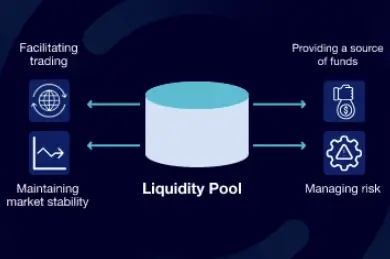
Liquidity pools combine funds from multiple users to enable trades without counterparties. Automated Market Makers set pricing rules and issue pool tokens to contributors. Traders swap against the pool, while liquidity providers earn fees proportional to their share. Prices adjust via constant-product formulas, creating exposure to impermanent loss if market prices diverge. Depth, volatility, and reward structures influence risk-adjusted returns. The mechanisms are clear, but practical participation requires careful assessment of incentives and risk.
Core Mechanisms of DeFi Liquidity Pools
DeFi liquidity pools enable decentralized trading by aggregating funds from multiple users into a shared pool.
Core mechanisms govern liquidity provisioning, pricing, and withdrawals through automated rules and on-chain records.
Pools align incentives via proportional liquidity shares and fee distributions.
Illiquid markets persist when liquidity is sparse or volatility spikes.
Oracle dependencies can influence pricing accuracy and settlement reliability.
How AMMs Power Liquidity Pools and Why They Matter
AMMs underpin liquidity pools by encoding price discovery and swap execution into automated rules, enabling direct exchange between paired assets without counterparties. This mechanism supports liquidity mining by aligning incentives with participation, implements slippage controls to limit price impact, highlights impermanent loss as a risk, and embeds governance incentives to align protocol evolution with user interests and decentralized stewardship.
See also: How Cloud Governance Improves Control
How Liquidity Providers Earn Fees and Rewards
Liquidity providers earn fees and rewards by supplying assets to liquidity pools and earning a share of transaction fees proportional to their pool participation. In practice, participants accrue fees and liquidity rewards from trades executed within the pool, distributed according to relative contribution. Returns depend on volume, while pool depth risks influence exposure, rewards timing, and capital efficiency.
Risks and Practical Participation: Impermanent Loss, Depth, and Safe Participation
Impermanent loss is a material risk when supplying assets to a liquidity pool, arising from price divergence between pool tokens relative to holding the assets outside the pool.
Participation requires awareness of depth concerns—liquidity, slippage, and capital locality influence exit timing and APR stability.
Prudence favors measured exposure, diversified pools, and ongoing monitoring to minimize risks while preserving freedom to optimize strategies.
Conclusion
Liquidity pools pool funds into a shared liquidity surface, enabling automated trading through constant-product pricing. AMMs determine swaps, while liquidity providers earn fees proportional to contributed liquidity. Rewards may come from incentives and governance tokens, offsetting risk exposure. Impermanent loss remains a core consideration, as price divergence affects relative value. Practical participation requires monitoring depth, volatility, and fee accrual. In a surprisingly anachronistic echo, one recalls ancient safekeeping of coin vaults, now digital liquidity vaults—precisely protected, transparently controlled, and relentlessly efficient.